Last updated 2026-08-18
TL;DR
Alaska has no state-level lead RRP board and no state licensing requirement beyond federal EPA certification. You certify once as a firm ($300) and as an individual renovator. There are no annual Alaska-specific renewal fees. What slows people down is not money, it’s finding the right 8-hour course, securing a certified renovator for each jobsite, and understanding Alaska’s cold-weather realities for containment in rural and Arctic conditions.
Do you need a license for lead RRP in Alaska?
No. Alaska does not operate its own lead renovation, repair, and painting program. The state never applied for EPA authorization under 40 CFR Part 745, Subpart Q. That means the EPA administers the Renovation, Repair and Painting (RRP) rule directly in Alaska. You do not get a license from the State of Alaska. You do not interact with an Alaska lead board. There isn’t one.
Instead, you comply with the federal rule by getting EPA firm certification and individual renovator certification. The EPA regulation states plainly: a firm must be certified to offer or perform covered renovations in any state without an EPA-authorized program [1]. Alaska is on that list. So anyone who disturbs painted surfaces for compensation in pre-1978 housing or child-occupied facilities needs an EPA firm certificate and a certified renovator assigned to the job.
You might see references online to an “Alaska lead RRP board.” That’s a misunderstanding. Some states have their own boards or programs (Alabama, Georgia, Oregon, etc.). Alaska does not. The Alaska Department of Environmental Conservation (DEC) runs a lead-based paint program for abatement, not for RRP. DEC confirms in its lead program materials that “EPA oversees renovation, repair, and painting activities in target housing” [2]. That’s the full story: no state license, no state board, just the EPA.
How Alaska’s program differs from a state-run board
In states that run their own programs, you’ll encounter distinct state applications, state fees, and state remittance addresses. Alaska contractors skip all of that. You work entirely through the EPA’s CDX system, an EPA-accredited training provider, and the EPA Region 10 office (which covers Alaska).
Here’s the practical difference. When you get EPA firm certification, you submit one application to the EPA, pay a single $300 fee, and receive a certificate valid for five years nationwide. No Alaska-specific add-on. No Alaska fee schedule. Your firm certificate number is issued by the EPA and covers work in every EPA-administered state, Alaska included.
What about local jurisdictions? Some Alaska boroughs or municipalities have their own building permit requirements, but none we could verify impose a separate lead RRP certification layer. The Matanuska-Susitna Borough, for instance, requires EPA certification as part of its contractor licensing for residential work, but does not issue its own lead RRP license [3]. This pattern is common across the state. Always ask your local building department, but understand that Alaska has intentionally avoided duplicating the federal rule.
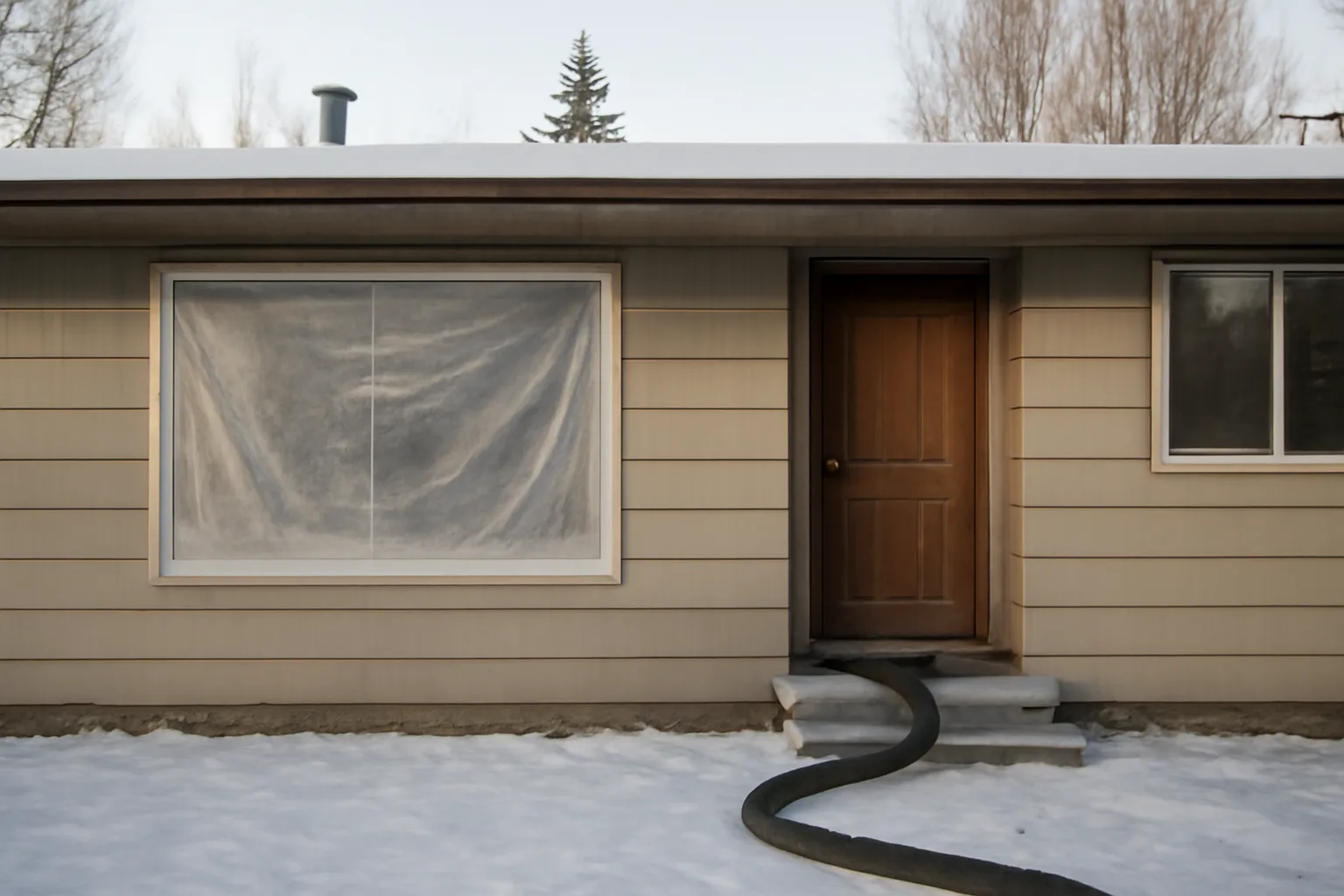
The biggest operational difference is geography. Alaska’s size and weather create real-world compliance headaches that a board structure wouldn’t fix, things like shipping HEPA vacuums to Bethel or keeping plastic sheeting from freezing to the ground in Fairbanks in January. Those are site problems, not policy problems, and the EPA offers specific cold-weather guidance for exterior containment that’s worth reviewing before your first winter job [4].
How much does lead RRP cost in Alaska?
The hard costs are straightforward. EPA firm certification costs $300 for a five-year term [5]. That’s a one-time payment, not annual. Individual renovator training costs are set by training providers, not the government. In Alaska, expect to pay $175 to $350 for the required 8-hour initial renovator course, with the higher end reflecting in-person courses that travel to Anchorage or Fairbanks [6]. The EPA-accredited course list is searchable and we found at least one provider scheduling courses in Anchorage as recently as 2024.
After the course, each renovator pays a separate $50 fee to the EPA for their individual certification application. That’s $50 per person, not per firm, valid for five years.
So the minimum spend to certify one firm and one renovator in Alaska runs about $525 to $700 total upfront:
| Cost Item | Amount | Frequency |
|---|---|---|
| EPA Firm Certification | $300 | Every 5 years |
| Initial 8-hour Renovator Course | $175, $350 | Once |
| EPA Individual Renovator Application | $50 per person | Every 5 years |
If you already hold an EPA firm certificate from another state, you don’t pay again. The certificate is federal and mobile. There is no Alaska transfer or notification requirement beyond ensuring your firm’s address is up to date in CDX.
What costs extra in Alaska? Travel and logistics. If you’re based in a hub like Anchorage, in-person training is accessible. If you’re in Nome, Ketchikan, or a village on the Yukon, travel to a training site is your real cost driver. Some firms absorb the cost of bringing a trainer to their community. Others send one person who then becomes the certified renovator for the whole crew, which the rule allows, as long as that person is able to be physically present at each worksite or direct non-certified workers via real-time contact and has someone on-site trained in the setup [7]. That’s the most common cost-savings play for remote Alaska jobs.
A note on the brand: if you’re looking for a one-shot kit that lines up the EPA firm application, the renovator application link, and a plain-English walkthrough of the CDX portal, there’s a $149 bundle available at /start. It’s not required. Some people prefer to track down every form manually; others just want a single checklist. Either path ends at the same EPA certificate.
How long does lead RRP take in Alaska?
Timeline breaks into two paths: getting certified, and executing a job under the rule.
Certification timeline: The EPA’s stated processing time for firm applications submitted online is typically 30 to 90 days [8]. In practice, online applications through CDX often complete within 30 to 45 days. The renovation training course itself is one full day, 8 hours, as mandated by the EPA model curriculum. So if you schedule the training, submit the CDX application immediately, and ask the trainer to issue your course completion certificate promptly, you can be fully certified within 4 to 8 weeks.
Job execution timeline: The RRP rule doesn’t set a minimum job duration. It sets required practices that shape how long work takes. You must post signs, contain the work area (plastic sheeting of at least 6 mil thickness for floors), shut down HVAC, use HEPA-filtered equipment, and perform a cleaning verification or clearance examination after the work. The EPA estimates that containment setup and cleanup add four to eight hours of labor for a typical window replacement job [9]. In Alaska, that estimate can double in subzero conditions. Plastic sheeting becomes brittle. Water for cleaning freezes. HEPA vacuums perform differently in very cold, dry air. Contractors in Fairbanks have told us off the record that winter exterior containment is not reliably doable without a tent and heat source, which isn’t in the EPA’s standard playbook but is the only way to keep sheeting from cracking.
For the record: the EPA’s formal estimate from the Economic Analysis for the final RRP rule assumes 2.0 additional hours for a small job (interior only) and 3.9 hours for average-sized jobs [10]. Plan for more time if you’re working outside in an Alaska January.
The actual paper you need on your first job
It’s a short list, but missing any one item means you are not in compliance. The EPA leaflet “Renovate Right” provides the required language, and you must give it to the owner and occupants before starting work [11].
Here is the paper stack for an Alaska job under the EPA RRP rule:
- EPA Firm Certificate. Must be posted or readily available on site.
- Certified Renovator certificate (for the individual overseeing the job). Must be on site.
- Signed pre-renovation notification acknowledgment from the occupant or owner. This confirms they received the “Renovate Right” pamphlet.
- Work practice checklist. This is not submitted anywhere; you keep it. It records that you followed required containment, cleaning, and verification steps.
- For exterior work in attached housing, the occupant notification requirements extend to all units sharing a common wall or ventilation.
Retain these records for three years from the completion date [12]. The EPA can request them via a random audit or a complaint-triggered inspection. Alaska’s DEC lead program staff coordinates with EPA Region 10 for enforcement, so a local complaint can escalate quickly to a federal record request.
One thing we hear repeatedly from Alaska renovators: the occupant acknowledgment is the hardest document to get signed when the owner lives in Anchorage but the property is in a village 200 miles away. The rule requires “before starting work,” which practically means mailing the pamphlet and getting a signed confirmation back by fax, email, or postal mail. We have not found an EPA exception for remote Alaska property owners; the requirement stands.
How to find Alaska training and stay current
The EPA maintains a searchable training provider locator at epa.gov/lead. As of mid-2024, it showed at least one accredited provider offering the initial renovator course in Anchorage; other providers list Wasilla and Fairbanks intermittently. The refresher course (required every five years for individual renovators) is 4 hours. Some providers offer it online, but the EPA requires the hands-on component for initial certification to be in person.
For firms: no refresher course exists, just a refiling of the firm application and fee every five years. The EPA sends a reminder letter to the address on file, but it’s a courtesy, not a defense if you miss it. Log into CDX once a year and check your expiration date.
What about lead-safe work practice updates? The EPA has not materially revised the required work practices since 2011. Minor amendments (e.g., clarifying the definition of a child-occupied facility) don’t require re-training unless the rule explicitly mandates it. Keep an eye on epa.gov/lead for the Federal Register notices. Region 10 also occasionally publishes Alaska-specific compliance alerts; subscribe through the EPA’s email list for Region 10 lead updates.
Who enforces the RRP rule in Alaska?
Enforcement authority rests with EPA Region 10, which covers Alaska, Idaho, Oregon, and Washington. The EPA may conduct inspections directly or coordinate with DEC via a performance partnership agreement. DEC’s lead program staff are cross-trained to recognize RRP violations and can refer cases to the EPA for enforcement.
Civil penalties for RRP noncompliance are federal, not state. The maximum penalty under the Toxic Substances Control Act is $46,307 per violation per day (adjusted for inflation as of 2024) [13]. In practice, EPA administrative settlements are far lower for first offenses, often in the range of $2,000 to $10,000, but the statutory maximum is available for knowing violations. Alaska has seen at least one EPA enforcement action against a firm for failure to use lead-safe work practices in multi-family housing; case details are public and traceable through ECHO, the EPA’s enforcement database [14].
This is not a theoretical risk. The EPA prioritizes child-occupied facilities and HUD-assisted housing. If a job involves those property types, documentation is scrutinized.
What Alaska contractors routinely get wrong
The most common errors we hear about from trainers and compliance specialists working with Alaska firms are not about the state. They’re about the federal rule.
1. Thinking a general contractor license is enough. Alaska’s Division of Occupational Licensing issues contractor licenses. That license does not include lead RRP authority. We have spoken with contractors who assumed that because Alaska has no lead board, no lead rules apply at all. That is wrong and expensive. 2. Skipping containment because the house is remote. Distance from inspectors doesn’t weaken the requirement. If a child is poisoned and blood testing traces lead back to your renovation, the lack of EPA certification and containment documentation can trigger civil and tort liability. 3. Using standard shop vacs. The rule requires a HEPA vacuum. In cold Alaska conditions, a non-HEPA shop vac is not a substitute. 4. Not factoring in the three-day lead-safe work practices before a renovation permit. Some Alaska building departments require proof of EPA firm certification before issuing a permit for residential work. Confirm with your local building official so you don’t arrive on-site with a crew ready to start and no permit.
These are the points that turn a profitable job into a penalty notice.
Why Alaska and the EPA program work well for small shops
No state board means no separate paperwork, no state fee, and no confusion about who sets the rules. It’s a single federal standard. For a small Alaska firm doing 10 to 20 renovation jobs a year, the administrative load is minimal once you’re certified.
The EPA’s compliance assistance documentation is explicit, and the cost certainty ($300 every five years plus one training course per renovator) makes budgeting predictable. Unlike California’s lead program, which adds a state fee schedule and additional reporting, Alaska’s path is identical to the majority of EPA-administered states and territories.
If you already operate in another EPA-administered state like Texas or Idaho, moving work to Alaska changes nothing on the paper side. The same certificate works. The same CDX login works.
What to do right now if you have a job pending
Step one: confirm the property was built before 1978. If yes, and you’ll disturb more than 6 square feet of interior paint per room or 20 square feet of exterior paint, the rule applies. No exceptions for Alaska. No rural exemption.
Step two: if you don’t already have a certified renovator on staff, find a course near you. Check the EPA locator, call the training provider, and ask for the next available date. If you’re remote and can’t travel, contact providers who offer “sponsored” courses where you bring them to your community if you can gather enough enrollees.
Step three: register your firm in EPA CDX now. Even if you’re waiting for a course date, get the firm application in. The processing clock starts when you submit. The fee is refundable only in specific narrow circumstances, so treat it as committed.
Step four: download the “Renovate Right” pamphlet from epa.gov/lead and the sample pre-renovation notification form. This is your owner-facing paper. Read it. The language you must use is scripted by the EPA.
Step five: order a HEPA vacuum and 6-mil polyethylene sheeting. If you work in cold conditions, consider ordering reinforced sheeting that holds up better in subzero temperatures. Some Alaska contractors we’ve spoken with use 10-mil poly with reinforced corners for exterior containment, which exceeds the EPA requirement but prevents callbacks.
If you want a single checklist that covers all of these steps with the right links and form numbers, the kit mentioned above is at /start. Use it or don’t. But don’t wait until the day before the job to begin.
A real-world Alaska timeline from zero to certified
We mapped out a realistic path for a small firm based in Wasilla, aiming to start an RRP job in July 2026:
- April 15, 2026: EPA CDX account created and firm application submitted ($300 fee paid).
- April 22, 2026: Firm owner attends EPA-accredited 8-hour course in Anchorage ($250 course fee).
- April 25, 2026: Owner submits individual renovator certification application with course certificate ($50 fee).
- June 2026: EPA Firm Certificate arrives (day 45-60 from application). Individual certificate arrives in similar window.
- July 1, 2026: First RRP-compliant job begins. Containment materials already on-site. “Renovate Right” pamphlet delivered and acknowledgment signed.
This timeline assumes prompt training, online CDX submission, and average EPA processing times. Mailed paper applications add two to four weeks to the firm certification time. Use the online path wherever possible.
For firms in Southeast Alaska where winter work is wet, or in the Interior where winter means minus-30 conditions, move your training and application push into spring. There’s no margin for a crew waiting on certification when a weather window opens.
Frequently asked questions
Is there a lead RRP board in Alaska?
No. Alaska has no state agency or board that administers the lead RRP rule. Alaska’s program is directly administered by U.S. EPA Region 10 [2]. You deal with the EPA’s CDX online system and EPA-accredited trainers, not a state body.
Do I need an Alaska state license for lead RRP work?
You do not need a state-issued lead RRP license. You do need an EPA firm certificate and have at least one EPA-certified renovator assigned to the job. The EPA firm certificate is federal and is your authorization to perform covered renovations in Alaska.
How much does a lead RRP certificate cost in Alaska?
EPA firm certification is $300 for five years. Individual renovator application is $50 per person for five years [5]. Training course costs run $175 to $350, set by private providers. There are no Alaska-specific fees. Total upfront for one firm and one renovator: about $525 to $700.
How long does it take to get EPA certified for lead work in Alaska?
The 8-hour training course is completed in one day. EPA processing of online firm applications typically takes 30 to 45 days, with a stated range of 30 to 90 days [8]. Plan on four to eight weeks from starting training to holding your certificate in hand.
Does the Alaska Department of Environmental Conservation handle lead RRP?
DEC handles lead-based paint abatement, inspections, and risk assessments, but not RRP. DEC confirms that ‘EPA oversees renovation, repair, and painting activities in target housing’ [2]. Contractors should coordinate with DEC for abatement projects and EPA for renovation.
Can I use my EPA RRP firm certification from another state in Alaska?
Yes. The EPA firm certificate is recognized in all EPA-administered states and territories. You do not need to reapply or notify the EPA when you begin work in Alaska, as long as your certificate remains valid and your CDX firm address is accurate.
What paperwork do I need on a lead RRP job site in Alaska?
You need your EPA firm certificate, the certified renovator’s certificate, signed occupant acknowledgment of receiving the ‘Renovate Right’ pamphlet, and a completed work practice checklist [11,12]. Retain all records for three years.
Where can I find lead RRP training in Alaska?
Use the EPA’s training provider locator at epa.gov/lead to search for accredited initial and refresher courses in Alaska. As of mid-2024, courses were available in Anchorage and intermittently in Wasilla and Fairbanks. Providers also may schedule courses on request for remote communities if demand justifies the travel cost [6].
What happens if I work without an EPA lead certificate in Alaska?
EPA Region 10 enforces federal RRP requirements in Alaska. Working without firm certification or violating required work practices can result in civil penalties up to $46,307 per violation per day under the Toxic Substances Control Act [13]. Actual fines for first offenses are often lower but escalate for repeat or knowing violations.
Are there cold-weather containment rules for Alaska RRP work?
The EPA’s required work practices are uniform, but the agency does publish guidance on cold-weather containment challenges. Recommendations include using heavier-gauge polyethylene sheeting, securing sheeting against wind, and using tents or heated enclosures when necessary to keep materials functional [4]. These are compliance aids, not separate regulations.
Do Alaska building departments check for lead certification?
Some do. The Matanuska-Susitna Borough construction contractor license application explicitly requires proof of EPA RRP firm certification for residential remodelers [3]. Other local jurisdictions may have similar permit prerequisites. Check with your local permit office before starting work.
Sources
- EPA: Lead Renovation, Repair and Painting Program Rules: EPA administers the RRP rule in states without an authorized program; Alaska is an EPA-administered state.
- Alaska DEC: Lead-Based Paint Program: Alaska DEC states EPA oversees renovation, repair, and painting activities in target housing, and DEC handles abatement only.
- Matanuska-Susitna Borough: Contractor License Application: MSB requires proof of EPA RRP certification as part of residential contractor licensing.
- EPA: Cold Weather Challenges for Exterior Renovations: EPA provides specific guidance on containment practices in cold weather, including heavier sheeting and use of tents.
- EPA: Lead Abatement and Renovation Firm Fees: EPA firm certification fee is $300 for five years; individual renovator application fee is $50.
- EPA: Search for Accredited Training Providers: EPA training provider locator lists accredited initial renovator courses, including those in Anchorage and Wasilla.
- EPA: Small Entity Compliance Guide to Renovate Right (40 CFR 745.85(b)): A certified renovator may direct non-certified workers if on-site or reachable by phone; a trained on-site person is required for certain tasks.
- EPA: Frequent Questions about Lead Renovation, Repair and Painting: EPA states firm application processing can take 30 to 90 days.
- EPA: Economic Analysis of the Final RRP Rule: EPA estimated additional labor of 2-3.9 hours per job for containment, cleaning, and verification under the RRP rule.
- EPA: RRP Rule Regulatory Impact Analysis: EPA analysis documents incremental time estimates for small and average renovation jobs under lead-safe work practices.
- EPA: Renovate Right Pamphlet Requirement (40 CFR 745.84): Renovators must provide owners and occupants the EPA 'Renovate Right' pamphlet and obtain acknowledgment before starting work.
- EPA: Recordkeeping Requirements for RRP (40 CFR 745.86): Records including certifications, notifications, and work practice checklists must be retained for three years.
- EPA: Civil Penalty Inflation Adjustments (2024): Maximum civil penalty under TSCA is $46,307 per violation per day as of 2024.
- EPA: ECHO Enforcement and Compliance History Online: EPA enforcement database contains records of lead RRP enforcement actions, including cases in Region 10 states.