Last updated 2026-08-18
TL;DR
Getting lead RRP certified in Arizona means two separate costs: about $300 for the required 8-hour initial renovator course from a private provider, and $300 for the EPA firm certification that covers you five years. Arizona runs no state add-on program, so you follow the federal EPA path directly. First-year hard costs settle near $600 per firm, plus your time and test kit supplies.
Do you need a license for lead RRP in Arizona?
You need an EPA lead RRP firm certification, not a state license. Arizona runs no authorized state program, so the Environmental Protection Agency governs lead RRP directly through Region 9. [1]
The Toxic Substances Control Act (TSCA) Section 402 and the Renovation, Repair, and Painting (RRP) Rule require any paid contractor disturbing more than 6 square feet of interior painted surface or 20 square feet of exterior painted surface in a pre-1978 home, child-occupied facility, or school to hold firm certification and use certified renovators. [2]
Individual renovators do not get a card from the EPA itself. They finish an EPA-accredited 8-hour training course, and the training provider issues a course completion certificate. The business entity applies to the EPA for firm certification, and that is the piece the law actually requires. Without a certified firm, even a trained individual cannot legally bid RRP work. [3]
There is no Arizona state licensing layer here. No Arizona Registrar of Contractors endorsement, no separate application to a state health department, no county RRP permit. Some contractors find out mid-project that their existing CR-42 or landscaping license does nothing for EPA compliance. That mistake gets expensive fast: the EPA can fine up to $41,056 per violation per day, as adjusted in 2025. [4]
Take a check to work on pre-1978 housing in Phoenix, Tucson, Flagstaff, or anywhere else in Arizona, and you need the EPA firm certificate in hand before you start.
How much does lead RRP cost in Arizona?
A realistic first-year Arizona lead RRP certification costs $550 to $700 per firm, not counting lost billable hours. The money splits into two purchases you cannot skip.
| Cost Item | Typical Range | Notes |
|---|---|---|
| EPA-accredited initial training course | $275 to $375 | One 8-hour class per renovator [5] |
| EPA firm certification application fee | $300 | Good for 5 years [6] |
| EPA certified renovator course completion | Often bundled with training price | Issued by the training provider, not the EPA |
| Lead test kits (optional but common) | $25 to $45 per kit | 3M LeadCheck or D-Lead; not required but used to prove a surface is lead-free |
Some Arizona providers run the initial course for as low as $249 in Phoenix and Tucson, though $295 to $325 is the realistic in-person price in 2026. Online live-stream options sometimes run $275. Verify the provider is on the EPA's accredited training provider list before you pay a dime. [5]
The $300 EPA firm certification fee is a one-time charge covering a 5-year cycle. No annual renewal fee exists at the federal level. After five years, you submit a recertification application and pay the $300 again. [6]
Here is the part that saves money. The law requires a certified renovator on site for certain phases of the work, not one for every worker. A single trained renovator, usually the owner or foreman, can oversee a crew of uncertified workers. So a 3-person crew operates legally with one trained renovator, and the per-firm cost stays near $600. [3]
What you never pay in Arizona: no state administrative fee, no Arizona Department of Health Services lead program fee, no county registration surcharge. California and Nevada run authorized programs with extra paperwork and cost. Arizona's direct EPA path saves you $200 to $400 compared with what contractors pay in state-run programs. [7]
How long does lead RRP take in Arizona?
You can be fully certified and legal in Arizona in 3 to 5 business days. The one real bottleneck is course scheduling, not government processing.
The training course takes 8 hours, usually a single weekday or a Saturday session. No apprenticeship hours. No field experience requirement. You attend, pass the hands-on assessment built into the course, and walk out with a certificate the same day. [5]
EPA firm certification is electronic. You submit an online application through the EPA's CDX system and pay the $300 fee. EPA guidance for the RRP program says firm certification takes "up to 90 days," but in practice most electronic applications clear in under a week. During Arizona's quiet construction months, approvals can land within 48 hours. [6]
Here is the timeline a Phoenix or Tucson contractor can reasonably expect:
| Step | Duration |
|---|---|
| Register for and attend the 8-hour initial renovator course | 1 day (offered most weeks in metro areas) |
| Apply for EPA firm certification online (CDX) | 1 to 3 business days processing (electronic application) |
| Receive firm certificate by email | Immediate upon electronic approval |
| Total, realistic minimum | 3 business days from course to certificate |
Submit your firm application Friday afternoon and the weekend adds two days. Paper applications sent by mail can take the full 90 days, and nobody should pick that route in 2026. [6]
Course availability is the constraint. In rural areas like Kingman or Show Low, accredited courses run less often, and you might wait 3 to 4 weeks for an open seat. Plenty of Arizona contractors drive to Phoenix for a one-day course rather than wait for a local class to fill.
Recertification training for existing renovators takes 4 hours, a half-day refresher required every 5 years. Those courses run roughly $125 to $175. [5]
What is the total first-year budget for Arizona lead RRP compliance?
A lean first-year budget for a solo Arizona operator lands between $700 and $800 with basic supplies, or $600 flat if your truck is already stocked. Here is the breakdown.
- Initial EPA-accredited renovator course: $295 to $325 (Phoenix metro provider, weekday rate)
- EPA firm certification fee: $300
- 3M LeadCheck test kit, pack of 8: roughly $40 (optional, used to rule out lead on a specific component)
- HEPA vacuum retrofit (existing shop vac with HEPA filter and bag, not a full HEPA vac): $30 to $50 if you lack compatible equipment
- Disposable coveralls, plastic sheeting, tape, and EPA-required warning signs: about $60 for the first job's kit
The RRP rule requires a certified renovator who finished training and a firm certificate. It does not require a business license from the Arizona Registrar of Contractors for RRP work specifically, though you likely need one for the underlying trade. No insurance mandate lives in the RRP rule itself, but your general liability carrier may want proof of certification to write or keep your coverage. [3]
The cheapest path: one in-person Saturday course at $249 plus the $300 EPA fee, totaling $549. Add sales tax on the course and a box of test kits, and you land at $600. That is the floor for Arizona in 2026.
LeadRRPPath sells a one-time EPA RRP and State License Kit at $149 that walks the paperwork path for Arizona and other states, but the only two costs you truly cannot skip are the training course and the EPA fee. Everything else is optional or already in your truck.
Where Arizona contractors overspend: buying a $1,200 HEPA vacuum they do not need, paying to train two or three renovators when one covers the crew, or enrolling in a $600 training bundle stuffed with materials they never open. The rule requires the work practices, not the branded shopping list.
What are the actual EPA work practice requirements and what do they cost to implement?
The certification gets you legal. The work itself costs more in time and materials than most new contractors expect.
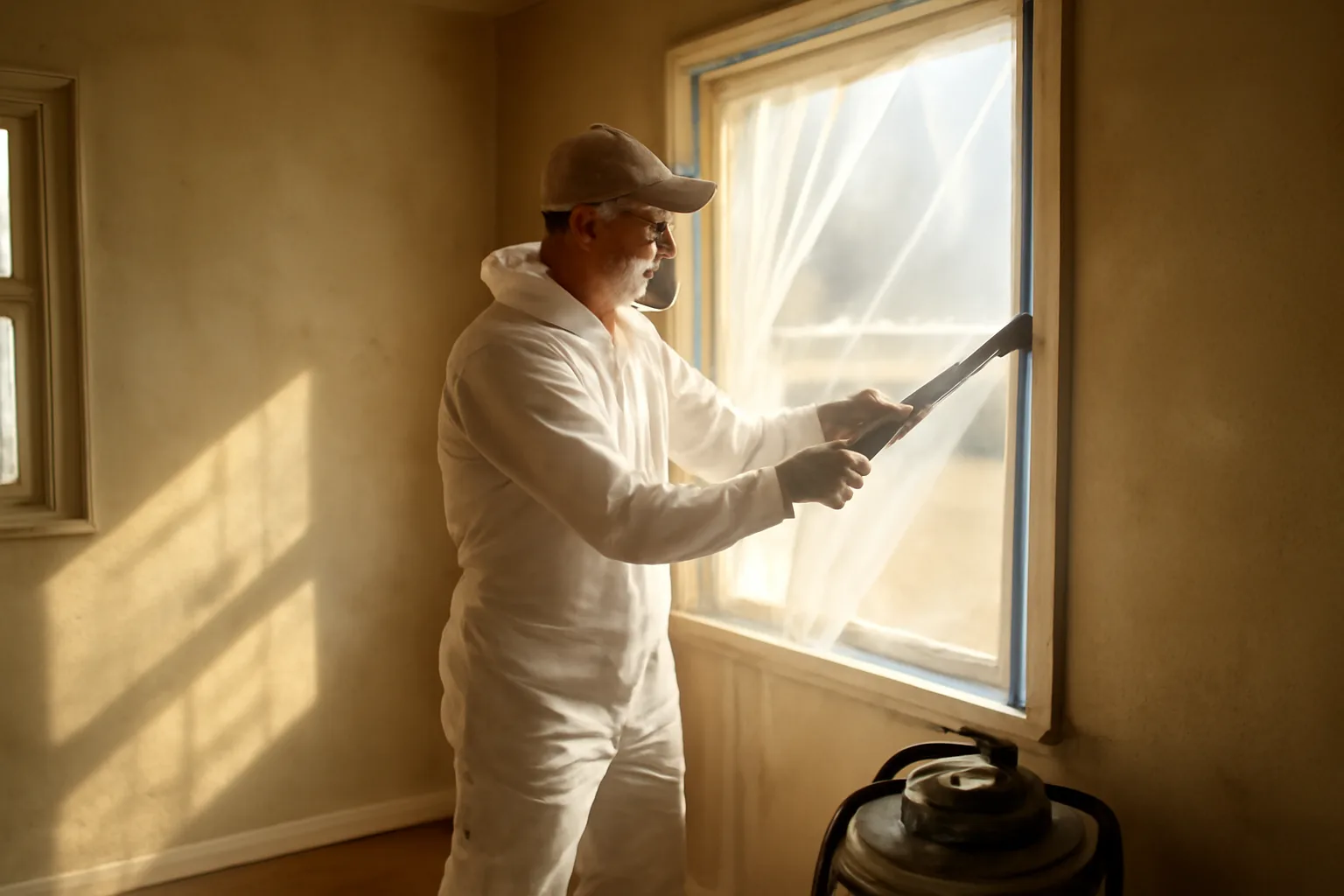
The RRP rule requires you to contain the work area with 6-mil plastic sheeting (roughly $0.30 per linear foot), cover floors with plastic, post warning signs, close windows and doors, and use a HEPA-equipped vacuum or wet methods for cleanup. After final cleaning, a certified renovator performs cleaning verification using EPA-approved methods. That is a wipe test comparing a cleaning sample to a reference card, not a lab analysis. [3]
A typical 200-square-foot window replacement in a 1950s Phoenix ranch home adds these costs:
- Plastic sheeting and tape: $15 to $25
- Warning signs: $5 to $10 (reusable)
- Disposable coveralls and shoe covers: $10 per worker per day
- HEPA filter bag and pre-filter for an existing shop vac: $25 (replace after the job)
- Extra labor for containment setup and teardown: 45 to 90 minutes total, $30 to $60 at Arizona prevailing rates
- Cleaning verification: 20 minutes, part of the certified renovator's duties, no extra consumables
Per-job RRP consumable cost lands at $50 to $100. The labor slowdown costs more than the plastic.
Exterior paint jobs in historic Tucson neighborhoods cost more to contain. The rule requires vertical containment extending at least 10 feet from the work surface, plus ground containment wide enough to catch falling debris. Swap plastic for rigid barriers on a large exterior project and containment can run $150 to $300. [3]
Nobody has good statewide data on how many Arizona contractors ignore these rules. The EPA runs enforcement inspections in Region 9, and Arizona gets its share of tip-driven investigations. A certified firm with clean paperwork and visible containment survives an inspection. A firm working uncertified with no containment risks $41,056 per violation if caught.
How does Arizona compare to neighboring states for lead RRP cost?
Arizona is one of the cheapest states in the West to get lead RRP certified, and the reason is simple: no state add-on program. The comparison matters if you work across state lines or you are relocating.
| State | State Program | Additional State Fees | Total Initial Cert Cost |
|---|---|---|---|
| Arizona | No (EPA direct) | $0 | $600 (course + EPA fee) |
| California | Yes (CDPH) | State fee + annual renewal | $925+ for first year [7] |
| Nevada | Yes (NDEP) | $100 state application fee | $700+ [8] |
| New Mexico | No (EPA direct) | $0 | $600 (same as Arizona) |
| Colorado | No (EPA direct) | $0 | $600 (same as Arizona; Colorado remains EPA-governed as of 2026) |
Do the snowbird circuit (Arizona winter, Colorado summer) and you need only the single EPA firm certification. No separate firm certificate per state. You operate under the federal program as long as the state is EPA-administered. [1]
California and Nevada require their own applications, fees, and sometimes state-specific training modules. The gap is real: a Phoenix remodeler pays $600, while a Los Angeles remodeler in the same national franchise pays close to double once state fees and state-specific training are done.
Arizona's cost advantage carries a catch. The EPA firm certificate covers the firm entity, not each individual job. Work in multiple states that run their own programs and you must follow the strictest state's rules for each job physically located there. A single firm certificate plus Arizona's lack of a state program keeps your overhead lean, but that certificate does not automatically satisfy California or Nevada.
Where can you take the lead RRP training course in Arizona?
EPA-accredited training providers run courses in Phoenix, Tucson, Mesa, and sometimes Flagstaff. The EPA keeps a searchable list of accredited training providers by state and region, and that list is where you start. [5]
In Phoenix, several providers teach out of centers near the I-10 corridor and the Deer Valley area. A typical in-person initial course runs $295 to $325. Tucson providers often run $275 to $300, sometimes with a small discount against Phoenix pricing. Online live-streamed courses, which the EPA permits, come from national providers at roughly $250 to $275.
Do not sign up for an online course without confirming it is live-streamed and EPA-accredited for initial certification. Pre-recorded, on-demand courses generally do not count for the initial RRP renovator training. The EPA requires a hands-on assessment, and live-stream providers handle it through interactive sessions and mail-in components. [5]
Refresher courses (required every 5 years, 4 hours) are widely available in Arizona at $125 to $175. Many contractors take the refresher online live-stream to skip the drive.
A common Arizona gripe: providers cancel classes on short notice in rural areas. In Yuma, Lake Havasu City, or Sierra Vista, plan to drive to Phoenix or Tucson rather than wait for a local class to fill. Sixty dollars in fuel and a lost day beats missing a bid deadline by three weeks.
What are the ongoing costs after the first year?
After the initial $600, ongoing Arizona RRP costs are modest but real. Here is what recurs.
- EPA firm certification renewal: $300 every 5 years. No annual fee. [6]
- Renovator refresher training: $125 to $175 per person every 5 years, 4-hour course [5]
- Lead test kits: $25 to $45 per job if you use them (not required, used as a defense when you think a component is lead-free)
- Consumable containment supplies: $50 to $100 per job
- Recordkeeping: the EPA requires you keep documentation for 3 years. That is a time cost, not a fee. A 3-ring binder and a photocopier cover it. Many firms keep a digital file with checklists, containment photos, and cleaning verification records. [3]
Add renovators and each new one costs a $275 to $325 course. No fee to the EPA to add a certified renovator to the firm. The person takes the course, and you add their certificate to the firm's records. [3]
Enforcement is the wildcard. As of 2025, EPA RRP penalties top out at $41,056 per violation per day. [4] In practice, EPA Region 9 settlements often run $2,000 to $20,000 for first-time offenders caught without certification. The $600 upfront cost is a rounding error next to even a small enforcement action.
What contractors get wrong about Arizona lead RRP costs
Seven mistakes Arizona contractors make about RRP cost, drawn from public enforcement records and training provider accounts:
1. Assuming the Arizona Registrar of Contractors license covers lead work. It does not. The EPA RRP rule is federal and separate. You need the firm certificate no matter your contractor license status. [2]
2. Thinking "I don't work on houses built before 1978." Arizona metro development boomed in the 1950s and 1960s. Entire square miles of Phoenix, Glendale, Tempe, and Tucson are pre-1978. Do residential work in central Phoenix or midtown Tucson and you are almost certainly in RRP territory.
3. Buying a HEPA vacuum before checking whether an existing shop vac with a HEPA filter and bag meets the rule. The EPA mandates no specific brand or model. A compliant retrofit can cost $50 in filters. [3]
4. Sending two or three employees to the course when one certified renovator can oversee the crew. The rule requires a certified renovator present during key phases of work. A single trained supervisor legally covers a small crew. [3]
5. Paying a consultant to "register your firm" with the EPA. The online CDX application takes 20 minutes. Anyone charging $500 for EPA firm registration is selling convenience, not access. [6]
6. Waiting to get certified until a client demands it. By then you have lost the job to a certified competitor, or you are scrambling to find a course before the start date.
7. Ignoring recordkeeping until an inspector shows up. The rule requires records kept for 3 years. Fail to produce them in 5 minutes for an inspector and your paperwork gap looks worse than the actual violation. [3]
EPA lead RRP firm certification application: step-by-step for Arizona
The process is not hard, but the EPA website buries the right link. Here is the straight path for Arizona applicants.
1. Finish the EPA-accredited 8-hour initial renovator training course. The provider hands you a course completion certificate. Keep the original and make a digital copy. [5]
2. Go to the EPA's CDX system at cdx.epa.gov. Create an account if you lack one. Select "Renovation, Repair, and Painting (RRP) Firm Certification Application." [6]
3. Enter your firm's legal name, physical address, and contact information. Use the exact name on your Arizona business tax records and Registrar of Contractors license, if you hold one. The EPA cross-checks identities.
4. Pay $300 by credit card or electronic check. Payment processes immediately. Print the confirmation page. [6]
5. Submit the application. The EPA sends a confirmation email. Approval arrives by email, typically within 2 to 5 business days for electronic applications. The PDF certificate is your firm's proof of certification. Print it and keep a copy in every work vehicle.
6. Arizona has no step 6. No state agency to notify. No county health department registration. You are done.
Held an RRP firm certification before and let it lapse? You re-apply as a new firm, including the $300 fee and a new initial training course for your renovator. There is no grace period. If it expired, you start over. [6]
A certified renovator course completion certificate never becomes void, but it stops satisfying compliance after 5 years unless you take the 4-hour refresher. The firm certification itself expires at the 5-year mark and must be renewed. [3]
What do Arizona RRP records and compliance actually cost in time?
Paper compliance costs almost nothing in money and more than you think in attention.
The RRP rule requires your firm to keep records of each RRP job for 3 years. That includes the certified renovator's training certificate, documentation of lead test kit results (if used), a written description of the work performed, the job location, and the cleaning verification records. [3]
A habit that works: shoot 3 phone photos of containment setup, 1 photo of the cleaning verification card next to the cleaned surface, and 1 photo of the finished job. Save them to a folder named by address and date. Add a one-paragraph work description in a Google Doc. Total time: 6 minutes. Record complete.
Run 40 pre-1978 jobs a year and that is 4 hours of recordkeeping annually. At $40 an hour for the owner's time, it costs $160 a year. Ignore it and get inspected, and the gap can turn a minor infraction into a findable violation. EPA inspectors often check records first, work practices second.
Test kit documentation saves money. Test a specific component, get a negative reading for lead, document it, and skip RRP requirements for that component. A $25 test kit can save 45 minutes of containment and cleanup on a single door or baseboard. Many Arizona contractors keep test kits in the truck specifically to rule out lead on doors, trim sets, and individual windows rather than assume the whole house needs full containment.
Frequently asked questions about lead RRP in Arizona
These are the questions Arizona contractors and property managers actually ask, based on training provider inquiries and contractor forums.
Can I use my California RRP certification in Arizona? Hold an EPA firm certification, or an equivalent from California's CDPH program, and it counts as a federal certification recognized in Arizona. But California requires its own certification to work in California. EPA certification alone does not satisfy California. Your federal firm certificate works in Arizona, New Mexico, Colorado, and every other EPA-administered state. [1]
Does lead RRP certification require a business license in Arizona? No. The EPA RRP firm certification is independent of the Arizona Registrar of Contractors and any municipal business license. But the underlying work (remodeling, painting, plumbing) likely requires a contractor's license under Arizona law if the job exceeds $1,000 including labor and materials. That is separate from the RRP certification.
Is online training accepted for initial certification in Arizona? Only live-streamed, EPA-accredited online training from a provider on the EPA's accredited list. Pre-recorded, on-demand courses do not count for the initial 8-hour renovator course. The EPA requires an interactive hands-on component, which live-stream providers handle during the session. [5]
How much does the recertification refresher course cost? $125 to $175, offered online live and in person, 4 hours. Required every 5 years for each certified renovator in your firm. [5]
Frequently asked questions
Do independent handymen need lead RRP certification in Arizona?
Yes, if you are paid to disturb paint in pre-1978 homes or child-occupied facilities. The RRP rule applies to anyone compensated for renovation, repair, or painting work, including sole proprietors and handymen. A one-person operation still needs firm certification and at least one certified renovator on site. The training and $300 EPA fee apply regardless of crew size. [2, 3]
Can I get a lead RRP certification without taking the in-person course?
You can take a live-streamed EPA-accredited online course. These require real-time interaction and a hands-on component managed by the provider. Pre-recorded, on-demand video courses do not count for initial certification. Refresher courses are more commonly available in live-stream format and are widely used in Arizona. [5]
How long does EPA firm certification last?
EPA firm certification is valid for 5 years from the date of issuance. You submit a recertification application and pay a $300 fee to renew. There is no annual renewal. Let the certification expire and you must re-apply as a new firm, which includes a new initial training course for your renovator. [6]
What fines does the EPA issue for RRP violations in Arizona?
The maximum civil penalty is $41,056 per violation per day as adjusted in 2025. Actual settlements in EPA Region 9 for first-time uncertified work often fall between $2,000 and $20,000. Criminal penalties are possible for knowing or willful violations. [4]
Are Arizona property managers required to have RRP certification?
Not for routine maintenance by employees working in the buildings they manage, as long as no outside contractor is paid to trigger the rule. If the property manager hires a renovation contractor, that contractor must be certified. If in-house maintenance staff are compensated for renovation work in pre-1978 buildings, those employees must be certified renovators and the owner entity must hold firm certification. [3]
Does the RRP rule require lead testing on every job?
No. You can use lead test kits to check whether a specific surface contains lead, and if it tests negative, RRP work practices do not apply to that component. Skip testing and you must assume lead is present and run full containment and cleaning. Test kits cost $25 to $45 per kit and are used on site by the certified renovator. [3]
Do I need to notify the Arizona Department of Health Services about lead RRP work?
No. Arizona has no authorized state lead abatement program requiring notification for RRP work. The federal EPA governs directly. There is no Arizona state notification requirement for renovation, repair, or painting projects, though full lead abatement projects fall under separate regulations with different rules. [1]
Can a painter with an expired RRP certification work on a pre-1978 house?
No. If your firm certification is expired, you are an uncertified firm and cannot legally bid or perform RRP work. If your individual renovator refresher training is expired (past 5 years), you must finish the 4-hour refresher before acting as a certified renovator on a job. [3, 5]
What is the cheapest way to get lead RRP certified in Arizona?
Find an EPA-accredited initial course priced at $249 to $275 (these prices show up in Phoenix and Tucson a few times a year), pay the required $300 EPA firm certification fee online, and use a single certified renovator to oversee the crew. Keep recurring costs low with existing shop vacs plus HEPA retrofits and test kits bought in bulk. Total: roughly $550 plus tax. [5, 6]
Does Arizona offer a grace period for RRP certification?
No. Federal EPA rules provide no grace period for lapsed firm certification. If your certificate expired yesterday and you start a pre-1978 job today, you are an uncertified firm subject to penalties. Reapply immediately before accepting new work. [6]
Are there grants or subsidies for RRP training in Arizona?
As of 2026, no Arizona-specific grant program covers RRP training for private contractors. Some workforce development boards or HUD grantees occasionally run subsidized training for lead abatement (a separate, more intensive certification), but not for the RRP renovator course. Private training providers set their own prices, usually $275 to $375. [5]
How much does RRP compliance add to a paint job quote in Arizona?
For a typical interior job, the added labor and materials for containment, cleaning verification, and documentation run $100 to $300, or about 5% to 10% on a $3,000 painting project. Exterior jobs using vertical containment cost more. Many Arizona contractors build a flat $150 to $250 RRP compliance line item into pre-1978 bids.
Sources
- EPA, Renovation, Repair and Painting Program: Authorized States, Territories, and Tribes: Arizona is not listed as an authorized state, so federal EPA administers the RRP program directly.
- Toxic Substances Control Act, 15 U.S.C. § 2682, Lead-Based Paint Activities Training and Certification: TSCA Section 402 governs training and certification requirements for lead-based paint activities including renovation and remodeling.
- 40 CFR Part 745, Subpart E, Renovation, Repair and Painting: Federal regulation setting RRP rule requirements for firm certification, renovator training, work practice standards, recordkeeping, and cleaning verification.
- EPA, Civil Monetary Penalty Inflation Adjustment Rule, 40 CFR Part 19: Maximum EPA civil penalty for TSCA violations is $41,056 per violation per day as adjusted for 2025.
- EPA, Search for Accredited Renovation, Repair, and Painting Training Providers: EPA maintains a searchable list of accredited RRP training providers by state; initial courses are 8 hours and refresher courses are 4 hours.
- EPA, How to Apply for Certification as a Renovation, Repair, and Painting Firm: EPA firm certification costs $300, is valid for 5 years, and is applied for through the CDX system.
- California Department of Public Health, Lead-Related Construction Certification: California runs its own lead-related construction certification program with fees beyond the federal baseline, unlike non-authorized states such as Arizona.
- Nevada Division of Environmental Protection, Lead-Based Paint Fees and Applications: Nevada imposes a $100 state application fee for lead-related construction certification, separate from EPA requirements.