Last updated 2026-08-18
TL;DR
Colorado has no separate lead RRP board. The EPA runs the Renovation, Repair, and Painting (RRP) rule directly. You need EPA firm certification ($300, good for five years) and at least one certified renovator. Training costs $200 to $400 and takes one day. Firm applications take up to 90 days. No state license exists.
Do you need a license for lead RRP in Colorado?
No. Colorado issues no lead RRP license, because the state runs no program of its own. Colorado is EPA-administered, so the federal Renovation, Repair, and Painting (RRP) rule applies directly [1].
To work legally you need two things from the EPA: a firm certification for your company and a certified renovator on the job. That's the whole list. There's no state board application and no CDPHE (Colorado Department of Public Health and Environment) credential for RRP. CDPHE handles lead abatement, not renovation, repair, or painting in target housing [2]. So the "board" is really the EPA Region 8 office in Denver, not a Colorado agency. One federal application, no parallel state filing.
Plenty of contractors starting out assume there's a local Colorado lead RRP board handing out licenses. There isn't. If someone pitches you a "Colorado RRP state license kit," walk away. You file with the EPA, and that's it.
Is Colorado an EPA-administered or state-run program?
Colorado is EPA-administered. The EPA states plainly that it "administers the Renovation, Repair and Painting (RRP) Program" in states that have not taken over the rule, and Colorado is one of them [1]. No state agency authorizes work, inspects sites, or collects fees for lead RRP. The EPA handles firm certification, training provider accreditation, and enforcement across the state.
This matters because a handful of states run the program themselves. Wisconsin, Iowa, Kansas, and others took over authorization, and those states often add fees or extra paperwork. Colorado does none of that. You skip it all.
You don't even send a copy of your EPA cert to CDPHE. The EPA stays your single point of contact. If you need something clarified, call EPA Region 8 in Denver or the national lead hotline, not a state office.
What the EPA lead RRP rule covers in Colorado
The RRP rule covers paid renovation, repair, and painting that disturbs lead-based paint in target housing and child-occupied facilities built before 1978 [3]. That's most single-family homes, apartments, and daycares with a child under age 6 regularly present.
Small jobs trigger the rule fast. Disturb more than 6 square feet of painted surface inside, or 20 square feet outside, and you're covered. Window replacement always counts, with no square-foot threshold at all. Sanding, scraping, and demolition count too, because they throw dust.
There are narrow exemptions. Work on components a recognized lab has certified lead-free is one. Minor repairs that don't disturb paint is another. But if you're bidding a pre-1978 house in Denver or Colorado Springs, assume you're covered and price it that way.
Who needs to be certified in Colorado?
Any firm that performs or offers to perform RRP work needs EPA firm certification. That covers sole proprietors, LLCs, and corporations alike [4]. The firm application covers your whole company, not each job site. At least one employee must be a certified renovator who passed the 8-hour EPA-accredited course.
The certified renovator is the on-site supervisor. They own lead-safe work practices and the record-keeping. Other workers don't need individual certification, but the certified renovator has to train them on the specific lead-safe procedures for that job before they touch anything [3].
Here's the part people miss: you don't certify every crew member, just the person directing the work. But that renovator can't be in two places at once. Run two crews at the same time in different spots, and each needs its own certified renovator on site.
How much does lead RRP certification cost in Colorado?
The only mandatory federal fee is the EPA firm certification: $300, nonrefundable, good for five years [4]. No state fee exists. The certified renovator training course costs whatever the accredited provider charges, usually $200 to $400 for the initial 8-hour class [5]. The EPA doesn't set or collect that fee. You pay the provider directly.
So your upfront cash to get legal is roughly $500 to $700: one firm fee plus one person's training. Need more certified renovators? Add $200 to $400 each. There are no review surcharges, fingerprint fees, or local business taxes tied to lead RRP. CDPHE won't show up asking for a cut.
Costs don't stop at the certificate. Firm certification renews every five years, another $300. Each certified renovator must finish a 4-hour refresher before the five-year mark, and that refresher carries a provider-set fee, usually lower than the initial course, around $150 to $250. Miss the refresher deadline and you retake the full initial course at the higher price.
For a $149 one-time kit that walks you through the EPA firm paperwork (no extra state forms needed in Colorado), LeadRRPPath lays out the path. It covers exactly what you file with EPA Region 8, step by step.
How long does lead RRP take in Colorado?
Training is fast. The initial renovator course is one 8-hour day. Refreshers run half a day. Find a provider with an open seat and you can have a certified renovator on staff tomorrow.
Firm certification is the slow part. Once the EPA gets a complete application (online or by mail) with the $300 fee, the agency says it "typically processes applications within 90 days" [4]. That's the official window. Many firms get the certificate faster, sometimes inside four weeks, but nobody can promise you anything shorter than 90 days.
You cannot operate as an RRP firm until you hold that certificate, paper or electronic. Start work during the wait and you're out of compliance, even with a trained renovator standing right there. Plan around it. Train the renovator, file the firm application right away, then use the wait to buy HEPA vacs, plastic sheeting, and warning signs and to set up your documentation system.
How to get EPA firm certification in Colorado (step-by-step)
Step one: have at least one certified renovator. Without that, the EPA won't process the firm application.
Step two: complete the firm application. Do it online through the EPA's CDX system or use Form 8500-27. It asks for your business name, address, and the certified renovator's training information [4]. Step three: pay the $300 fee by credit card, check, or money order. Step four: submit. Done.
Want the paper path in one package without hunting down forms? The $149 LeadRRPPath EPA RRP Kit includes the application checklists and sample forms for EPA-administered states like Colorado. One purchase, no subscription. You can also do the whole thing yourself for free straight from the EPA's firm application page.
Once approved, the EPA mails your certificate (or you get a digital copy if you applied online). Post a copy at your office and carry one to job sites as proof. It's valid five years. Set a reminder to renew about 90 days before it expires.
How to get individual renovator certification in Colorado
No EPA application needed for the individual. Just training. Use the EPA's Lead-Safe Certified Training Provider Locator to find an accredited provider near you [6]. In Colorado, providers run classes in Denver and Colorado Springs, and traveling courses sometimes reach mountain towns.
You register, pay the provider, sit the full 8-hour class, and pass the hands-on and written assessments. The provider issues your renovator certification.
That certificate is yours, not the company's. Change firms and it goes with you. Renewing is simple: take a 4-hour refresher before the five-year expiration. Let it lapse and you repeat the full 8-hour class. Some renovators wait too long and pay twice. Don't be one of them.
Required lead-safe work practices in Colorado
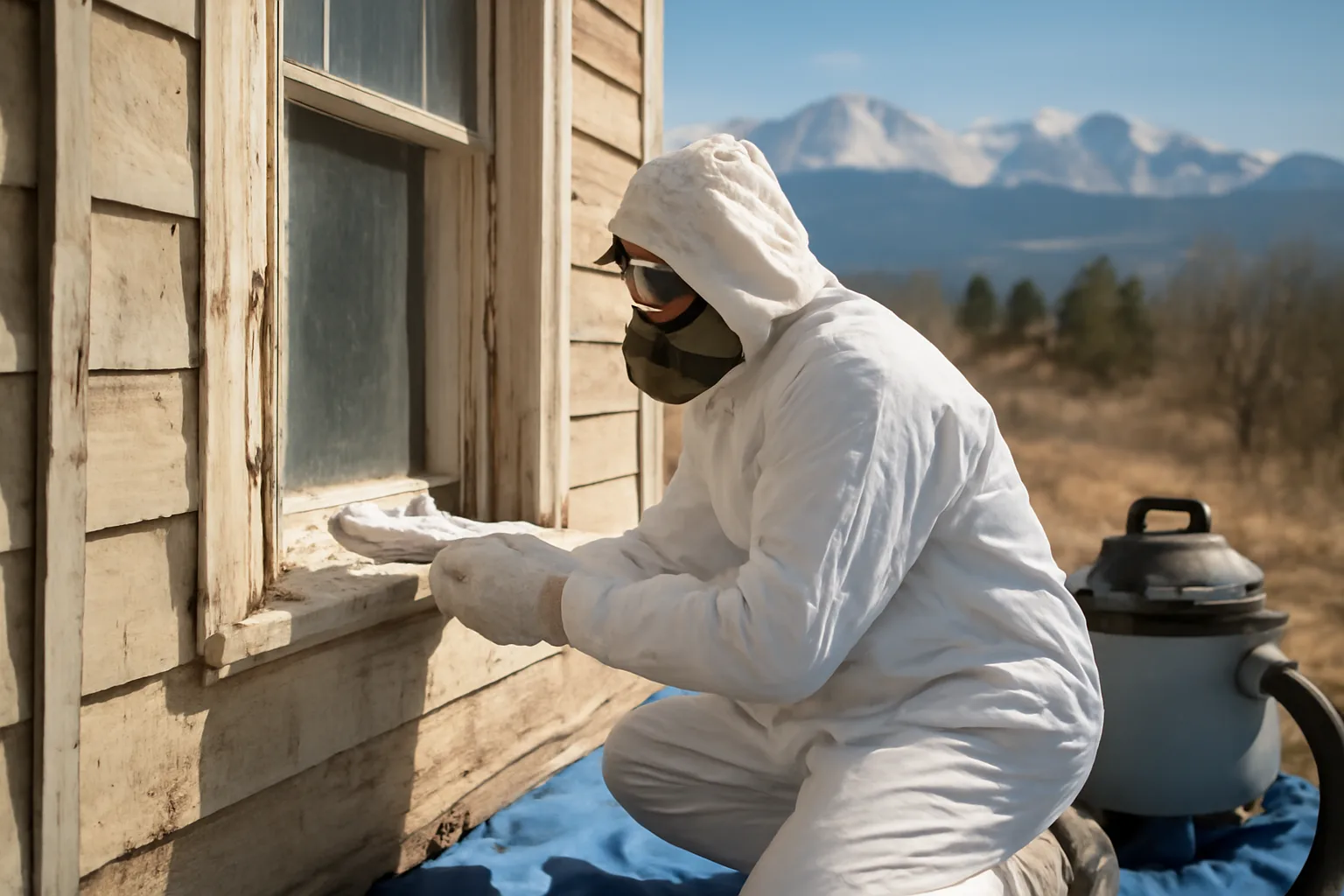
Colorado follows the federal rule, so the work-practice standards are identical to every other EPA-administered state. Contain the work area with plastic sheeting. Cover floors and HVAC vents. Post warning signs. Keep dust down with wet methods and HEPA sanders. Clean up with HEPA vacuums and wet wiping [3]. Open-flame burning is out, and so are heat guns above 1,100 degrees Fahrenheit.
At the end of each job, the certified renovator performs a post-renovation cleaning verification, using EPA-recognized cleaning verification or, where allowed, clearance testing. You also must give the adult occupants the EPA's Renovate Right pamphlet before work starts and get a signed acknowledgment or a certificate of mailing [7].
Keep every record for three years: training certificates, project documentation, and pamphlet acknowledgments. When an EPA inspector shows up, they ask to see paperwork before they ask whether the work was clean.
Renewal and recertification for Colorado contractors
Firm certification expires five years from the date the EPA issued it. Reapply exactly like the first time and pay the $300 fee again. There's no automatic self-renewal. You submit a new application. Let the firm cert lapse and you stop all RRP work until you have a fresh one. No grace period.
Individual renovator certifications also expire after five years. The 4-hour refresher must be done before that date. Some providers run weekend refreshers, which helps if you're squeezed.
If your renovator is within a month of expiration, book the refresher now. The bigger risk is a lapsed renovator cert, which can force you to hire a replacement or pause work until they redo the full initial training.
Penalties for lead RRP violations in Colorado
EPA enforcement is real, not theoretical. Civil penalties can reach $37,500 per violation, per day [8]. A firm that works a pre-1978 home without certification and without a certified renovator can face tens of thousands in fines, even if nobody got sick. Criminal penalties are on the table for knowing and willful violations.
EPA Region 8, based in Denver, runs inspections and follows up on tips. Common triggers are competitor complaints, tenant reports, and random checks.
The defense is boring and it works: airtight paperwork and obvious, clean containment. Pay the $300 firm fee and train your people. That's cheap next to what a violation costs.
Common mistakes Colorado contractors make with lead RRP
The costliest mistake is skipping certification because the job looks small. The square-footage triggers surprise people. Scraping a single double-hung window can blow past 6 interior square feet on its own.
Then there's the pamphlet. A lot of guys do textbook containment and forget to hand over Renovate Right, and the EPA cites them for that alone.
Another pattern: letting one certified renovator cover crews in different locations. The rule requires a certified renovator to direct the work and be present for certain tasks. Running three basement remodels across town on the same day means you need three renovators, not one.
Poor records sink more firms than poor dust control. The EPA wants training certificates, job logs, and pamphlet acknowledgments for every project. A single missing page is a violation, even when the work itself was spotless.
Resources and contacts for lead RRP in Colorado
Start with the EPA's main lead page for anything RRP in Colorado [1]. For questions, use the national EPA lead hotline at 1-800-424-LEAD. To find a class, the EPA Training Provider Locator [6] does the job.
Need lead abatement instead of RRP? That's CDPHE's lead program [2]. Don't mix the two. Abatement is permanent removal of lead hazards, and Colorado requires separate abatement contractor and worker licenses from CDPHE. Repaint a pre-1978 living room and you're in RRP territory, not abatement.
Comparing rules across the West? We've written guides on Lead RRP in Arizona and California's state-run program. For a cost angle, our Utah cost breakdown shows a similar EPA-administered setup.
Ready to get lead RRP certified in Colorado?
You can start tomorrow. Book an initial renovator class through a Colorado provider, then file the EPA firm application the moment you have the cert in hand.
If you want a paper package that holds your hand through the EPA form, LeadRRPPath sells a $149 EPA RRP Kit. One time, no state add-ons. It covers what an EPA-administered shop needs and nothing more.
Planning to work across state lines? Check how the process shifts elsewhere: Lead RRP board in Connecticut and Florida's setup are both EPA-administered with their own quirks. For a midwest example, see Illinois's program.
Frequently asked questions
Do you need a license for lead RRP in Colorado?
No state-issued license exists for lead RRP in Colorado. Colorado is an EPA-administered state. You must have an EPA firm certification and at least one EPA-certified renovator. The Colorado Department of Public Health and Environment does not issue RRP credentials. The process runs entirely through the EPA.
How much does lead RRP certification cost in Colorado?
The EPA firm certification fee is $300, nonrefundable, for a five-year term. Individual renovator training costs $200 to $400 for the initial 8-hour course, depending on the provider. There are no state fees. Refresher courses run about $150 to $250 every five years per renovator. First-year costs for one firm and one renovator usually land between $500 and $700.
How long does lead RRP take in Colorado?
Renovator training takes one 8-hour day. EPA firm certification processing can take up to 90 days from receipt of a complete application. You cannot legally offer or perform RRP work until the firm certificate is issued, so start the application as soon as you have a trained renovator.
Is Colorado an EPA-administered state for lead RRP?
Yes. Colorado is EPA-administered, not state-run. The EPA directly oversees firm certification, renovator training accreditation, and enforcement. The Colorado Department of Public Health and Environment (CDPHE) handles lead abatement licensing, not RRP.
Can I get lead RRP certified online in Colorado?
The EPA firm certification application can be completed online through the EPA's CDX system. Individual renovator training requires in-person attendance at an EPA-accredited course. No fully online initial course satisfies the hands-on training requirement.
What is the penalty for not having lead RRP certification in Colorado?
The EPA can impose civil penalties of up to $37,500 per violation, per day. Fines for working without firm certification or a certified renovator can quickly reach six figures. Criminal charges are possible for knowing violations.
Do I need a CDPHE license for lead RRP?
No. CDPHE licenses lead abatement contractors and workers, not RRP firms. If you perform renovation, repair, or painting that disturbs lead-based paint in target housing, you fall under EPA RRP, not CDPHE abatement requirements.
Where do I send the EPA firm application for Colorado?
Apply online through the EPA's Central Data Exchange, or mail your paper application, fee, and supporting documents to the address listed on Form 8500-27. Colorado has no separate submission location. Processing is handled nationally, with Region 8 overseeing compliance.
Do all my workers need to be certified in Colorado?
No. Only one certified renovator must be in charge of each work crew. Other workers must receive on-the-job training from the certified renovator before they start lead-disturbing tasks, but they don't need individual EPA certification.
How often do I need to take lead RRP refresher training?
A certified renovator must complete a 4-hour EPA-accredited refresher course before their initial certification expires, generally five years from the date of the initial course. If certification lapses, the person must retake the full 8-hour initial course.
Does Colorado require a lead inspector for RRP work?
No. The RRP rule does not require a lead inspector or risk assessor at renovation sites. The certified renovator performs post-renovation cleaning verification. An inspector is needed only for abatement projects or when the property owner requests clearance testing.
Can a handyman do lead RRP in Colorado?
A handyman or sole proprietor can perform lead RRP work if they get EPA firm certification and become a certified renovator. There is no handyman exemption. Failing to get certified before disturbing paint in pre-1978 homes violates federal law, regardless of business size.
Sources
- EPA: Colorado is an EPA-administered state; EPA handles RRP firm certification and training accreditation.
- Colorado Department of Public Health and Environment: CDPHE lead program covers abatement only; does not issue RRP credentials.
- EPA: RRP rule requirements: target housing, child-occupied facilities, work practice standards.
- EPA: EPA firm certification fee is $300; processing typically takes 90 days.
- EPA: Training course fees vary by accredited provider; EPA does not set prices.
- EPA: EPA lead-safe certified training provider locator tool.
- EPA: Requirement to distribute the Renovate Right pamphlet before starting work.
- EPA: Civil penalties up to $37,500 per violation per day under the lead RRP rule.